
The attention drift bubble
Field note for Week 10 · Days 61–67 · Eric MacDougall
A company can generate more plans, summaries, tickets and code than ever before while fewer people can explain why any particular decision was made. One employee has AI draft a proposal. Another asks AI to summarize it. A third uses AI to turn the summary into tasks. Agents implement those tasks. Each handoff sounds reasonable; the original condition can vanish somewhere between the source and the action.
I call the accumulating liability attention debt: commitments for which the source, caveat, owner or reasoning cannot be reconstructed cheaply. If enough of those commitments build up while dashboards show rising throughput, the organization may be growing a risk bubble. That is a hypothesis to measure in a given company, not a claim that an industry-wide failure rate has been established.
The problem is bigger than model hallucination. A summary can be grammatically correct and contain no invented fact while omitting the one exception that made the decision safe. A subsequent agent can faithfully act on that incomplete summary. Lower single-step hallucination does not repair a broken chain of attention.
An example: the condition that disappeared
Consider a fictional product company negotiating a pilot with a large customer. The source decision says: offer the feature for ninety days to this tenant, subject to a security review before external data enters the workflow. A sales assistant drafts a rollout note. A manager's assistant compresses it to: the ninety-day pilot is approved. A planning agent creates implementation tasks from that sentence. A coding agent opens the feature to the tenant. The security review was not rejected. It simply stopped being represented.
No single participant has to lie. The first AI may produce a useful note. The second may summarize most of it accurately. The task agent may implement the summary exactly. The defect is in the organization: it let a compressed artifact become the authority for an action without checking the original condition and owner.
If you ask the last agent why the feature was opened, it can cite the task. The task cites the summary. The summary may no longer carry the condition. The audit trail exists as a pile of text, but the causal chain is gone.
Evidence of a mechanism, not a measured bubble
There are relevant research signals. Mohamed and colleagues' ACL 2025 paper observed accumulating distortion in translation-based iterative generation experiments. Perez and colleagues at ICLR 2025 studied LLM-to-LLM transmission chains and found biases and attractor effects that depended on the input and instructions. Lost in the Middle found that information position affected studied long-context retrieval and question-answering tasks. These are not direct measurements of the fictional company above, nor universal statements about all 2026 models. They establish plausible failure mechanisms worth testing in your own workflow.
Gao and colleagues' ALCE benchmark evaluated whether citations supported generated answers in studied question-answering datasets. It motivates checking the exact source passage against a claim rather than treating a document URL as evidence of approval. It does not measure citation failures in enterprise decision chains.
The human side matters. A CHI 2025 survey of 319 knowledge workers associated higher confidence in GenAI with less self-reported critical-thinking effort, while greater confidence in one's own task skill related to more. It is an association based on self-report, not proof that AI causes an organization to stop thinking. It supports asking whether the right people actually examined the right sources at consequential decisions.
Four kinds of drift
The first is loss: a condition or exception disappears in compression. The second is invention: a plausible but unsupported detail enters the new artifact. The third is substitution: an easy metric or proxy replaces the original objective. The fourth is staleness: a previously valid decision survives after its time, customer context or policy has changed.
The pilot example is loss. “The customer asked for unrestricted data access” would be invention. “Ship the feature this sprint because task count is the goal” is substitution. Reopening the same access after the ninety-day pilot expires is staleness.
These modes interact. A role agent can have durable memory and still preserve only the wrong summary. A retrieval system can return the latest ticket while missing a caveat in the recorded decision. A long context window can contain the right document while the model gives weak attention to the decisive clause. The fix is not to stuff every participant with every historical note.
A decision packet, not another summary
For a consequential action, I want a small structured packet that survives each handoff:
| Field | What it must carry |
|---|---|
| Decision and scope | What was authorized, for which customer/cohort and for how long |
| Source links | The original record and exact passage supporting each material claim |
| Conditions | What must happen first and what must never happen |
| Evidence and uncertainty | What is observed, inferred or still unverified |
| Dissent | An unresolved objection or alternative that changes the action |
| Owner and expiry | Who may revise the decision and when it must be rechecked |
| Next action | The bounded step proposed, with expected target-state readback |
This packet is not a magic schema. A valid packet can contain a wrong source link, or a supervisor can fail to update it. Its value is that missing fields and contradictions become inspectable before an agent executes a task. It also creates a practical round-trip test: give the downstream agent only the packet and ask it to recover the original condition and identify which source would change its action. If it cannot, the handoff is insufficient.
The OpenAI Agents SDK explicitly provides input filters for handoffs, and its context documentation distinguishes application context from what the model sees. That is a useful implementation surface. It does not guarantee that a filtered handoff retains the necessary facts. The application must decide what evidence to inject and verify what the receiver understood.
Use role agents to carry responsibility, not just more text
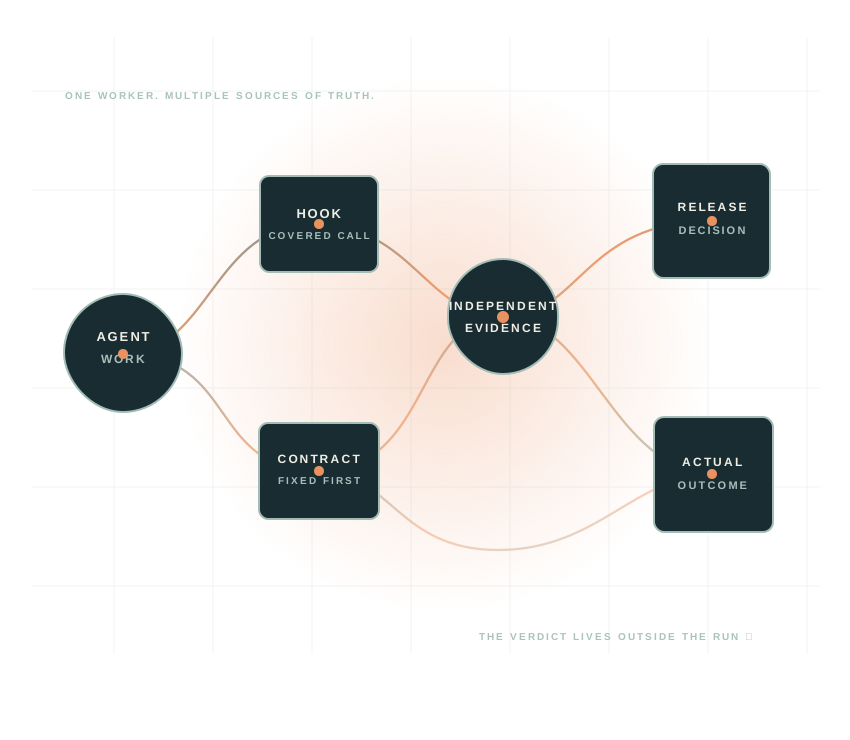
One practical design is a supervising set of small, durable roles. A policy steward holds the current approval and expiry. A customer steward holds the customer's actual exception and source. An architecture steward knows the impacted system boundaries. Each can send a narrow, source-linked constraint to the working agent at the moment it matters. A monitor compares the resulting action with the packet and the target state.
This needs more than a plain top-k lookup over tickets. Retrieval can be structured, hybrid, version-filtered or triggered by an event; designed well, it can surface the current source-linked constraint. The additional control I want is persistent decision ownership and active conflict detection at the action boundary. A versioned decision store, watched by a deterministic rule or a policy steward, can inject the active constraint when a task crosses that boundary. The role agent can select and explain it, but its message remains a claim. The protected source-and-version lookup, named human owner and application action gate supply authority. Role agents should never become a private, unaudited policy layer.
The system needs a compact injection record: which role sent which constraint, source ID, decision version, receiving agent, timestamp, acknowledgement and outcome. That record lets us test whether the packet crossed the handoff instead of assuming it did.
Budget attention where it changes the outcome
I do not want everyone manually reading every generated page. That would just move the bottleneck. I want a named human to inspect the source at decisions that change customer rights, money, safety, external commitments or architecture. Routine low-stakes formatting can move quickly. A promotion from proposal to authorized action should require a deliberate source check and owner, with a time budget matched to the consequence.
The NIST AI Risk Management Framework and its Generative AI Profile emphasize governance, measurement, documentation and traceability. They do not define my packet or prove an attention bubble. The operating choice here is to make human attention an explicit control rather than an invisible hope.
Ten tests for an organization's handoff chain
These are proposed, synthetic probes for a single company. They have not been run against Eric's workplace or customer records:
- Put one decisive “subject to review” clause in the source and run the usual draft-summary-task chain. Measure whether it survives unchanged.
- Put the clause in the middle of a long document and compare with a short source-linked packet. Do not infer a universal model ranking from one run.
- Add a plausible unsupported sentence to a summary. Require the next agent to mark it as unsourced rather than promote it to action.
- Give two sources that conflict on the pilot end date. The handoff must surface the conflict and name the decision owner.
- Revoke a decision after a task was created but before execution. The acting agent must see the new version and stop.
- Provide a valid-looking packet whose source link points to the wrong customer. The source/identity check must fail.
- Omit the named owner. The consequential action must wait for assignment rather than defaulting to the most recent message sender.
- Ask a downstream agent to explain the original condition using only the handoff packet. Score recovery against the authoritative source record.
- Let a role agent inject a stale constraint. A separate version and expiry check must reject it.
- Complete an authorized action, then read back the real target state and ask the owner whether it still matches the original objective.
Keep the original source immutable for the experiment. Record retention of material conditions, unsupported additions, false approvals, correction time and whether a human opened the source. These measures are more revealing than counting AI-generated documents.
I ran one local, deterministic negative-control set against the draft decision-packet companion. All seven fixture tests passed. Changing a fictional pending security prerequisite into permission to review after launch produced FAIL; a complete packet produced PASS for fidelity only, with execution authorization still false. This tests the checker on synthetic files; no model, real company decision or external action was exercised.
Watch the leading indicators
I would track orphaned decisions with no owner, actions with no source link, expired exceptions still in use, caveats lost in handoffs, reversals caused by misunderstood intent, and time required to reconstruct a consequential decision. Watch the distribution by team and workflow. If those rise while generated output rises, the organization is accumulating attention debt.
My rule: before AI-generated work becomes another agent's instruction, bind it to the original decision, preserve the conditions and uncertainty, name the owner, and verify the downstream action against the source. Do this because a company can automate every handoff and still lose the one thing it needed to keep: deliberate attention to why it is acting.
Sources and limits
- Mohamed et al., ACL 2025 (S167) and Perez et al., ICLR 2025 (S168): bounded iterative-transmission experiments.
- Liu et al., Lost in the Middle, TACL 2024 (S169): position effects on studied long-context tasks.
- OpenAI Agents SDK handoffs and context (S170): implementation surface, not an outcome guarantee.
- NIST AI RMF and Generative AI Profile (S171): voluntary governance resources.
- Lee et al., CHI 2025 (S172): survey association, not causal workplace audit.
- Gao et al., ALCE, EMNLP 2023 (S177): generated-answer citation support on studied QA tasks, not enterprise approval rates.
The pilot and role-agent design are illustrative. “Attention debt” and “bubble” are Eric's proposed organizational lenses, not measured industry statistics. Test the ten probes on a company's real consent-safe workflow before making local claims.
The field kit
The companion folder for this week holds runnable examples, decision records, evidence and limits. The repository release log is updated after each article's live readback.